

Two Easy Ways to Start Earning Rewards!
Become a member today! Members-only pricing and offers, personalized care notifications, Vital Care points back on every purchase and more!
 Become a credit card member today!
Earn 2X Pals Rewards points at Petco
when you use Petco Pay!APPLY NOWLearn More About Petco Pay Benefits
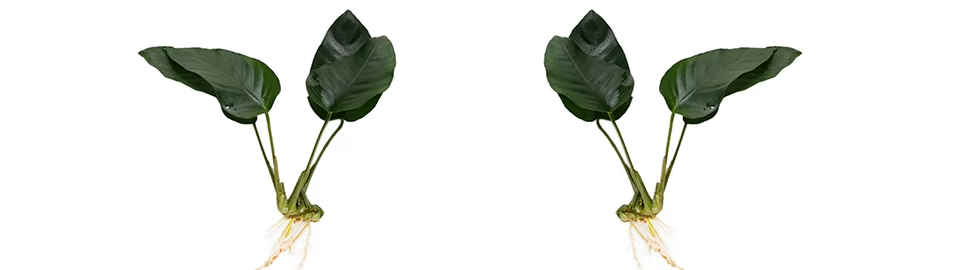
Sera Artificial Aquarium Plants


Related Articles & Questions
- New Pet
Master Aquatic Plant Care: Lush Aquarium Plants & Happy Fish
Tanks with live plants can be excellent additions to your home, bringing a touch of nature indoors. Learn how to take care of aquatic plants.
Updated on November 6th, 2025
- Health & Wellbeing
Revive Your Aquarium Plants: Fix Nutrient Deficiencies for Lush Growth
Are your aquarium plants nutrient deficient? Petco is here to help you identify different deficiencies such as light, nitrogen, co2, magnesium, iron and more.
Updated on October 23rd, 2025
- New Pet
Anubias Nana Care: Easy & Beautiful Aquarium Plant for Beginners
Do you want to know how to keep your aquarium water clean & oxygenated? Visit Petco and check out our Anubias nana guide.
Updated on October 23rd, 2025
- New Pet
Java Fern Care: Easy Guide to a Thriving Aquarium Plant for Beginners
Java ferns are aquatic plants that are great for aquariums. Visit Petco to learn about Java fern types, planting, care and more
Updated on October 23rd, 2025
 Product Guides
Mini Aquarium Guide: Setup, Care & Maintenance for Small Spaces
Small, AKA “Nano” tanks have grown in popularity over the past couple years and continue to gain momentum. Find out if a mini aquarium is right for you.
Updated on October 23rd, 2025
- Health & Wellbeing
will an iron rich fertilizer hurt my fish? I just got a Green Wendth to help my small aquarium with 2 small neon fish. i am tring to naturally balance the environment. Do i need to get specific rocks for the bottom? oh , i also got one of those g
When used as instructed, plant nutrients and fertilizers designed specifically for aquarium plants will not harm aquarium fish. Allow new aquarium plants to settle and establish themselves before adding any fertilizers. Use aquarium plant substrates such as CaribSea Eco-Complete Plant Substrate http://www.drsfostersmith.com/product/prod_display.cfm?pcatid=9087 to get your plants established faster. Seachem Flourish Advance Natural Phytohormone Supplement http://www.drsfostersmith.com/product/prod_display.cfm?pcatid=33890 will help stimulate root growth vital for overall plants health. Even though you have plants with low to moderate light requirements, be sure to use aquarium light specifically designed for planted aquarium use (sometimes called plant lights) and have the lights on between 10 and 12 hours a day. You may need to adjust the photoperiod (the amount of time the light is on) depending on how your plants are doing and to prevent unwanted nuisance algae growth.
Updated on September 24th, 2025
- Food & Nutrition
What types of fish should I buy because I'm a beginner in this . I have a 1 feet tank . One more thing I have heard that live-bearers could be best But I want your suggestion. And also what other Things I should buy and can you tell me a site that ca
Without anything to use for scale, it is hard for me to tell how big your tank is, but in general it seems very small. Also, the water that is in the tank appears very cloudy right now, so that would be the first place to start. Water quality is very important, and will make or break your ability to house and care for fish. I would recommend getting a good filter system (you can visit a local pet store to assist you with brands in your area, as I am not familiar with what you can get in India). Be sure to bring the measurements (height, length, width) of your tank, or the gallons or liters so they can tell you what capacity of filter you will need. Everything else will depend on what types of fish you get - if you plan on getting multiple fish, they will need to be small - a general rule of thumb is one square inch of fish per gallon of water. Depending on the species you get, you may need to also get a bubbler to ensure there is enough oxygen in the water for them, and you will also
Updated on September 24th, 2025
- Health & Wellbeing
I would like to know how I can make my goldfish live the longest possible life they can and how to add more decor after I added the water and conditioning today and I am going to go get my fishies I think I am going to go with two but how to properly
Gold fish can make great fish but they can live up to 25 years and require a large tank that may need to be upgraded if they grow too large. Do get at least 2 fish. Here are some links which may help: https://www.petcoach.co/article/chewing-in-puppies-how-to-control-it/ https://www.aqueon.com/information/care-sheets/goldfish https://www.hartz.com/how-to-introduce-new-fish-into-your-aquarium-tank/ I hope this helps and congrats on your new pets!
Updated on September 24th, 2025
- Health & Wellbeing
One of my goldfish has fin rot. I just relocated them in a new tank (they were in a bad tank with bad water before, they have backstory that’s not important right now) with new water and all that, I only noticed the fin rot after relocating them. I h
Thanks for reaching out about Timothy & Lola. Have you tested the water for pH, ammonia, nitrites and nitrates? Correct any problems. Adding non-iodized salt (aquarium salt) at 1 tablespoon per 10 gallons can reduce osmotic stress but is probably not a treatment for fin rot. If fin/tail erosions progress, antibiotics might be needed, therefore a veterinary visit. Good luck.
Updated on September 24th, 2025
- Health & Wellbeing
My fish tank got infested with pink algae and green algae and the fish are acting lethargic and dying.
Check the water chemistry using a home test kit or submit a water sample for testing. The local Petco may do this for free or for a small fee. Aim for an absence (0 ppm) of ammonia and nitrites with nitrates at 20ppm or less. Perform partial water changes to stabilize chemistry and/or to improve water quality. Rinse the filter media in tank water, not tap water, and replace it. Use only conditioned water that is temperature matched to prevent stress or shock. To limit algae growth, maintain pristine water quality via filtration and regular water changes. If possible, turn up filter flow to keep water moving. If this stresses the fish though, do not do it. Do not overfeed and remove any uneaten food promptly. Limit lighting to 8 hours daily and closely monitor water temperature as well. All these can promote algae overgrowth.
Updated on September 24th, 2025